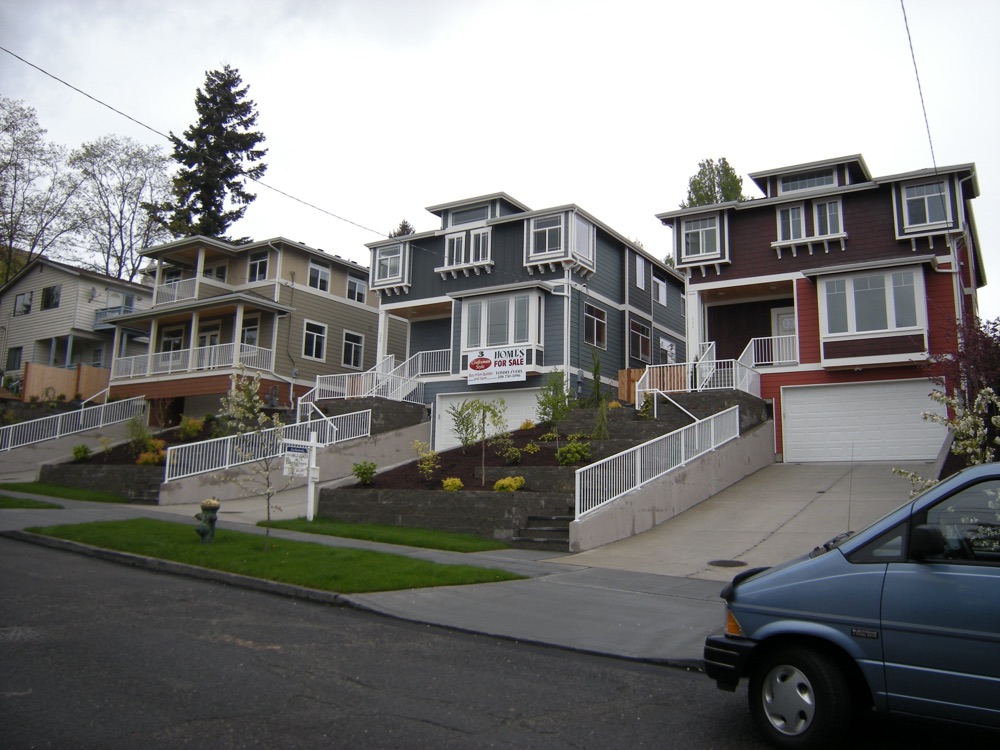
A homeowner on a Seattle residential lot now sits at a fork I never saw in my years on the job. One path: a detached ADU — a backyard cottage — that keeps the house and the mortgage you already have. The other: a fourplex that replaces the house and reworks the whole parcel. Both are legal on the same lot under the Neighborhood Residential rules Seattle adopted with Ordinance 127376. The difference between them is not zoning. It is money, and the money changes by neighborhood.
Here is the dollar side of the decision, in plain numbers, so you can stop guessing which one pays.
The DADU keeps your house and pays down its own debt. The fourplex bets the whole parcel. Both can pencil out — but never on the same lot for the same reason.
DADU vs. fourplex: the two build-outs on the same lot
Take a 5,000-square-foot Ballard lot with an older house. Here are the two versions of its future. Both paths run through the same middle-housing rules Seattle adopted to comply with HB 1110.
The DADU path. You leave the house standing and build a 1,000-square-foot, two-bedroom cottage in the rear yard. At the $420–$616-per-square-foot design-and-build band that is $518,500 at the midpoint ($420,000 to $616,000), before your parcel's permits, studies and site prep. The house keeps its value, the yard shrinks, and you add exactly one rentable unit. It rents for about $2,700 a month — the cross-source median of five September 2026 Seattle two-bedroom asking-rent series.
The fourplex path. You take the house down and build four attached or stacked units — say, four one-bedrooms of roughly 900 square feet each. Middle-housing construction runs lower per square foot than a custom single house because the walls, roofs, and utility runs share, but the total is far higher. At a planning estimate of $325 per square foot — a labelled assumption, not an engine figure — 3,600 square feet runs about $1.17M. Four one-bedrooms at $1,950 each gross $7,800 a month.
Same lot. Roughly 2.3 times the cost, and 2.9 times the rent. The question is whether the house that stays standing, and the $651,500 of capital you avoid spending, are worth more to you than the extra units.
One lot, two build-outs
Build cost and 15-year gross rent, side by side. Planning estimates, not quotes.
DADU at 1,000 sq ft priced on this site's engine band ($420–$616/sq ft design and build, midpoint $518,500; permits, studies and site prep are separate). Fourplex at 3,600 sq ft × $325/sq ft — a labelled planning estimate, not an engine figure. Rent from the engine's cross-source September 2026 asking-rent table: 2-bd $2,700/mo, 1-bd $1,950/mo × 4 units. Gross rent, before vacancy, expenses, taxes, and financing.
Lot size, transit walkshed, coverage, trees and the house you already have decide which of these two build-outs your lot can actually carry. The customized report measures all of them for one address.
What each one earns after the bills it carries
Gross rent is the number builders put on the sign. The number that matters is what is left after the recurring bills Seattle and King County keep sending.
King County capacity charge. A DADU is billed 0.59 of a residential customer equivalent — $46.01 a month for 15 years, about $552 a year. A fourplex creates four new units, each charged its own RCE, so the capacity charge scales with the unit count and runs several times the DADU's. The DADU figure is published; the fourplex figure is a planning estimate until the county quotes your connection.
Property tax. King County revalues every parcel annually, and the new units land on the next roll. At Seattle's levy code 0010 rate of $9.90845 per $1,000 — about 0.99% — a DADU that adds $450,000 of assessed value adds roughly $4,460 a year. A $1.17-million fourplex adds about two and a half times that, because the assessment follows the value, not the unit count.
SPU drainage. The flat per-parcel drainage fee — $469.52 a year for a 2,000-to-3,499-square-foot parcel, $976.13 for 6,500 to 9,999 — does not change when you add a DADU under 10,000 square feet. A fourplex on the same parcel sits in the same tier, so drainage is not the line that separates the two. The capacity charge and the property tax are.
Cost and income, per unit
The fourplex spreads its cost across four doors; the DADU carries it all on one.
DADU: 1,000 sq ft on this site’s engine band ($420–$616/sq ft design and build, midpoint $518,500); 2-bd rent $2,700/mo. Fourplex: $1.17M ÷ 4 units; 1-bd rent $1,950/mo. Planning estimates — the fourplex costs less per door but commits four doors' worth of capital and displaces the house.
When the DADU still wins
The fourplex wins on total rent. The DADU wins on everything else a homeowner actually has to live with, and that is most lots in Seattle.
- Capital. A $518,500 cottage is a construction loan. A $1.17M fourplex is a development project — different lender, different terms, and a house you have to take down first.
- The existing house. If the house is sound, you keep an asset worth several hundred thousand dollars and add income behind it. Tearing it down writes off that value to buy four units.
- Coverage and trees. On a small or heavily treed lot, four units may not fit at all. A single cottage fits far more often. The setback and lot-coverage rules (SMC 23.44) are the same ones that decide whether the fourplex is even a real option.
- Risk. One tenant is one tenant. Four doors mean four turnovers, four leases, and four sets of repairs. The DADU is the smaller bet, and on a 5,000-square-foot Ballard lot it is usually the bet that actually closes.
If the lot qualifies, a pre-approved standard plan is the fastest way through the front end of the DADU path — a shorter plan review and a cheaper design step before a single board is cut.
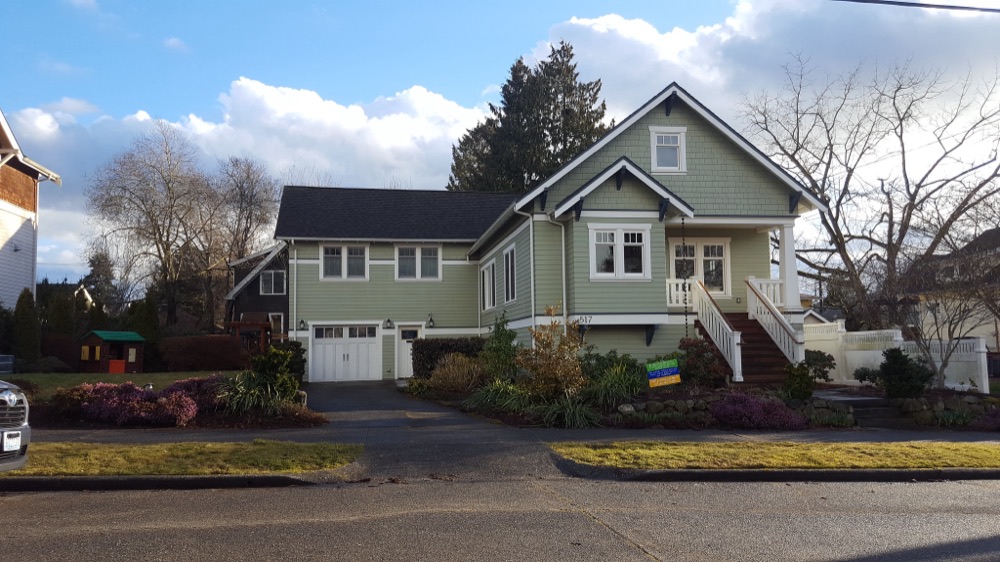
On a large, clean lot near transit — think Wedgwood's big parcels, or the light-rail walksheds around Northgate and Columbia City — the fourplex starts to make sense, because six units are allowed near transit and the greater-of density rule (one unit per 1,250 sq ft) adds units on large lots. That is where the middle-housing capacity report earns its price: it tells you which of the two futures your specific lot actually qualifies for.
Your unit count under HB 1110, the transit walkshed, the density math, and a simple massing — so you know whether a cottage or a fourplex is even on the table for your address. $49, delivered as a PDF.
The number that decides it
If I had to put the whole decision in one sentence: the DADU is the choice when you want income without giving up the house, and the fourplex is the choice when the lot is worth more than the house standing on it. The second half of that sentence is not something a state FAQ can tell you. It is a measurement of your parcel — coverage, trees, slope, transit, and what the existing structure is worth — and the customized feasibility report measures this for your address.
Before you sketch either one, run the numbers for your lot. The neighborhood profiles show the measured lot-size and zoning patterns, and the free homeowner checklist is the fastest way to screen whether a cottage is even viable before you think about four units. For the deeper step, the Seattle DADU Pro Guide walks the full checklist on your own parcel.
Frequently asked questions
Is a DADU or a fourplex a better investment in Seattle?
It depends on the lot and the capital. A DADU is a smaller, lower-risk addition that keeps the house, costing roughly $420,000 to $616,000 to design and build at 1,000 square feet, before permits, studies and site prep. A fourplex maximizes rent but is a redevelopment — roughly 2.3 times the build cost and the loss of the existing house. On gross rent, a DADU often pays back faster per dollar; a fourplex earns more in total.
How much does it cost to build a fourplex in Seattle?
Middle-housing construction runs lower per square foot than a single custom home, but the total is much higher. As a planning estimate, four roughly 900-square-foot units at about $325 per square foot run about $1.17M, versus roughly $518,500 for a 1,000-square-foot DADU. Get written bids and confirm density with SDCI.
Does a fourplex pay more than a DADU in Seattle rent?
In total, yes. Four one-bedroom units at about $1,950 a month gross $93,600 a year, versus a two-bedroom DADU at about $2,700 a month, or $32,400 a year. But the fourplex requires roughly 2.3 times the capital and replaces the existing house, so the return per dollar invested is not automatically better.
Should I keep my house and build a DADU, or redevelop into a fourplex?
Keep the house and build a DADU when the existing structure is sound, you cannot finance a full redevelopment, or coverage, trees, and critical areas limit what fits. Consider a fourplex when the lot is large and clean, near transit, and the house has little remaining value. A lot-capacity screen and the feasibility report measure these for your address.
Keep reading. For the state law behind the four-unit number, HB 1110 on your Seattle lot. For the DADU side in detail, the year-by-year Seattle DADU payback math.
This article is educational and preliminary. It is not financial, investment, legal, or architectural advice, and it is not an official determination by the City of Seattle, SDCI, or King County. Rent, cost, and fee figures are planning estimates from public data and may differ materially. Verify unit counts, fees, and values with SDCI and King County, and consult qualified professionals before making financial, design, or construction decisions.