
I get asked the same question after every cottage I framed: what is the return. The honest answer to a Seattle DADU ROI question is that the rent pays you back slowly — about year 17 on a cash build at today's costs — and the real money shows up later, in the value the cottage adds to your property. Here is the payback math year by year, on a two-bedroom cottage, with every number pulled live from the same engine that runs the calculator on the home page, the $59 ROI projection and the feasibility report. If those numbers move, this page moves with them.
The number that matters is not the rent. It is the rent after the quiet bills — vacancy, a manager, the King County capacity charge, and a property tax bill that grows with the value you just added — and after the maintenance you will actually carry.
The payback is real, but it is a fifteen-to-twenty-year story, not a three-year one. Cash makes it a steady 4.7 percent once the unit is leased. A 7.25 percent HELOC makes it a negative in year one. Know which one you are before you pour the slab.
— Bob Hall, retired Seattle builderWhat a Seattle DADU costs to build, all in
Before the return means anything, the cost has to be honest, and the cost has to be labelled. Seattle DADU builders publish a turnkey figure — design, permits, construction, utilities, site work and contingency together — and in 2025–2026 that band is $400 to $650 a square foot. Ballard Backyard Cottages states it as an all-in average and puts a 1,000-square-foot unit at $375,000 to $550,000 typical, $625,000 high; Maksymov Brownstone quotes $400 to $650 a foot for construction and $300,000 to $600,000 all-in; Piper Cole Architects' 900-square-foot two-bedroom runs $360,000 to $480,000 before an $18,000-to-$38,000 architect; Emerald City Construction quotes $500 to $700 a foot. The line-by-line cost guide walks the whole stack.
This site prices your permits, studies and site prep for your own parcel, line by line, so the band it carries is the design-and-build share of that turnkey number: $420–$616 per square foot, being $375 to $550 of hard construction plus 12% for design, engineering and contractor overhead. Add a typical fee envelope and you are back inside the builders' $400-to-$650. Nothing is counted twice; the pieces are the builders' number itemised.
I size the example as an 800-square-foot, two-bedroom detached cottage, which is a common Seattle program and rents like a proper two-bedroom without hitting the 1,000-square-foot ceiling. Three numbers matter:
- Best case — $336,000, the bottom of the band. A clean, flat lot with a short sewer run and no surprises.
- Typical — $414,500, the midpoint and the working number this article runs against.
- What recent Seattle builds are actually costing — $493,000, the top of the band, and where a lot of 2025–2026 permits are landing.
Inside that typical $414,500, and on top of it, are three buckets:
- Hard costs — the building itself, $370,000 at the midpoint (about $463 a square foot). A small unit carries a kitchen, a bath, a foundation and a panel that do not shrink in proportion.
- Soft costs — design, structural engineering and the contractor's overhead, modelled at 12% of hard cost: $44,500.
- Permits, studies and site prep — $18,150 on a neutral parcel, priced the way the feasibility report prices them: SDCI plan review & building permit (custom path) $4,450; Trade permits (electrical, mechanical, plumbing) $1,450; SPU side-sewer permit, drainage SDC & water connection $3,000; Topographic / boundary survey $2,750; Arborist report $600; Utility trenching / side-sewer routing to main $4,650; Erosion / drainage control (small site) $1,250. The SDCI anchor is the 2026 fee summary's worked example (a 500-square-foot DADU at $3,453 for plan review plus permit), scaled to 800 square feet.
That stacks to $432,650 in on a cash build, the number the rest of this article runs against. It is a planning estimate, not a bid — the customized feasibility report measures this for your address, because alley, slope, trees, sewer and panel are the items that move the total.
One honest caveat before the math. The SDCI permit records the site's engine pulls for every address show a median declared value of about $196,270 for DADU permits issued citywide since 2024 — less than half the $414,500 midpoint. That is not a cheaper way to build. The declared value on a permit is the construction valuation SDCI sets the permit fee on: in practice the Building Valuation Table rate (about $186 a square foot — the 2026 fee summary prices a 500-square-foot DADU at $93,145) times the floor area, or the contractor's building-shell figure. It leaves out design, permit and utility fees, the utility connection, site work and contingency, and it is a schedule rate, not a 2026 bid. Divide $196,270 by $186 and you get a unit of roughly 1,054 square feet — at or above the 1,000-square-foot cap for a two-bedroom — which at that cap costs $420,000 to $616,000 to design and build. That is why this worked example runs on $414,500 and shows $336,000 and $493,000 beside it.
The rental income and ROI projection runs the same fifteen-year model on your parcel: build cost, rent, vacancy, operating costs, the capacity charge, property tax, and cash versus a HELOC.
The recurring bills that follow the cottage
The closeout check is not the last one. Several bills keep arriving after the tenant does, and they are why the top-line rent and the net are two different things. The percentages below are the engine's defaults — the same ones behind the calculator and the $59 projection — each with its source.
King County capacity charge. The county charges $77.99 per residential customer equivalent per month for 15 years, and a DADU is 0.59 RCE. That is $46.01 a month, $552 a year, and $8,283 over the full term. King County applies the charge to new sewer connections, additions and changes of use, so a DADU does not dodge it.
SPU drainage. A flat per-parcel fee billed on the property tax statement, set by lot size: on a 2,000–3,499 sq ft lot it is $469.52 a year in 2026; on a 6,500–9,999 sq ft lot, $976.13. Your parcel already pays its tier, and a cottage does not change the tier on a lot under 10,000 square feet, so the added drainage cost of a DADU is $0 — which is exactly what the calculator books. An earlier version of this article booked the whole $469.52 tier against the cottage; that double-counted a bill the house already pays.
Property tax on the added value. King County revalues every parcel annually, and the cottage lands on the next roll. At Seattle levy code 0010 — $9.90845 per $1,000, about 0.99% — $414,500 of new value adds $4,107 a year. That one line dwarfs the capacity charge.
Vacancy, lease-up, maintenance, management, insurance. The soft ones nobody writes down. The engine models vacancy at 6% of gross rent (Seattle apartment vacancy was 6.7% in Q2 2026 per Kidder Mathews, 4.6% per CBRE) plus one month of lease-up in year one; maintenance and a small capital reserve at 7% of effective rent (the 5–8% norm for a new build; the reserve rises after year ten); professional property management at 8% of effective rent (Seattle firms charge 8–12%); a standalone landlord policy at $1,000 a year (an ADU rider on the house policy runs $300–$800, a standalone policy $500–$1,500); and Seattle's RRIO registration at $175. Manage it yourself and the management line drops to zero: year-one net rises from $17,759 to $19,979, but your own time is not costed. These are assumptions, and where a rosy spreadsheet falls apart.
Where the year-one rent actually goes
Planning estimates — a $2,700/mo two-bedroom cottage, $32,400 gross.
Light = vacancy & lease-up $4,644. Bronze = maintenance, management, insurance & RRIO $5,338. Ink = capacity charge & property tax $4,659. Green = net operating income $17,759.
Gross rent $2,700/mo: the cross-source median of five September 2026 Seattle two-bedroom asking-rent series (Zillow $2,695 · Zumper $2,650 · Apartment List $2,437 · Apartments.com/GPS Renting $2,855 · RentCafe $2,878), rounded to $25; the band is $2,425–$2,700. Vacancy 6%, one month lease-up, maintenance 7%, management 8%, insurance $1,000, RRIO $175, capacity charge $552, added drainage $0, property tax $4,107 — the engine's dated defaults.
That is the first lesson: out of $32,400 in rent, about $17,759 is yours before any debt. The other $14,641 disappears into vacancy, the manager, the County, the Assessor and the wear on the building. Build the return on the $17,759, not the $32,400.
Seattle DADU ROI, year by year: the payback
On rent, the engine uses $2,700 a month for a two-bedroom citywide — the median of the five published series above (Zillow's own two-bedroom average is $2,695). A new detached cottage with its own yard often asks above the apartment average, but no Seattle DADU-rent index measures that premium, so the base case does not add one. From there rent grows 2% a year for 3 years (Seattle asking rents are flat-to-down year over year as of September 2026) and 3% after; vacancy, maintenance and management stay at 6%, 7% and 8%; insurance and RRIO creep up 3% a year; property tax is held flat; and the capacity charge runs its 15-year term.
Cumulative cash position on a $414,500 cash build
Starts at −$432,650 (build plus fees); net operating income accumulates and crosses zero about year 17.
| Year | Gross rent | Net after expenses | Cumulative position |
|---|---|---|---|
| 1 | $32,400 | $17,759 | −$414,891 |
| 5 | $35,415 | $22,315 | −$329,484 |
| 10 | $41,055 | $26,612 | −$205,274 |
| 14 | $46,208 | $30,535 | −$89,164 |
| 15 | $47,594 | $31,590 | −$57,574 |
Planning estimates, not a projection. Financing cash purchase; rent growth 2%/yr for 3 years then 3%/yr; vacancy 6%; 1-month lease-up in year 1; maintenance 7% and property management 8% of effective rent; insurance $1000/yr and RRIO $175/yr, both growing 3%/yr; property tax 9.90845/$1,000 on the added value, held flat; King County capacity charge $552/yr for 15 years; SPU drainage added cost $0. All estimates (◇). The cumulative position starts at −$432,650 and crosses zero about year 17; the 15-year cash position is −$57,574, and with the building itself counted at cost the 15-year wealth position is $356,926.
Read that table the way I do: a cash-built cottage pays for itself about year 17 on rent alone, and everything after that is the return on an asset you still own. The reason it still makes sense is the part after the rent — the value the cottage adds to the parcel.
Cash versus a HELOC: financing changes the answer
The same cottage is a different investment depending on how you pay for it.
Built with cash. No debt service, so the $17,759 first-year net is yours from month one. On $432,650 in, that is a 4.1% cash-on-cash return in year one and 4.7% once the lease-up month is behind you, and it stays positive every year.
Built on a HELOC. Most Seattle owners build against equity in the house they already own, not with a construction loan. Say you draw $331,600 — 80% of the $414,500 build — at 7.25% (Bankrate's national HELOC average, 7.11% in mid-September 2026, rounded up) on a 20-year amortization, with 2% closing costs. The payment is about $2,621 a month — $31,452 a year — against $17,759 of first-year net. That is negative leverage: the cottage costs you −$13,693 in year one on $107,682 of your own cash, and it stays cash-flow negative until rent growth catches the payment (payback about year 25). At year 15 you still owe $131,575, but you also own $282,925 of a building you paid $107,682 toward.
The 20-year term is the part that bites. A 30-year amortization, or an interest-only draw period while the cottage is built and leased, changes the picture, and so does the rate. Run your own numbers at your own rate in the calculator before you commit.
What actually moves the payback
The payback year is not a law of nature; it is the build cost, and the band is wide.
Sensitivity: best case, typical, and recent Seattle builds
Planning estimates — the same cottage, rent and fees at three points on the build-cost band, paid in cash.
| Scenario | Year-one net | Cash-on-cash, year 1 | Payback |
|---|---|---|---|
| Best case ($336,000) | $18,537 | 5.2% | year 14 |
| Typical ($414,500) | $17,759 | 4.1% | about year 17 |
| Recent Seattle builds ($493,000) | $16,981 | 3.3% | about year 20 |
HELOC on a $331,600 draw, 20-year amortization: at 6% the payment is about $2,376/mo (−$10,753 in year one); at 7.25% about $2,621/mo (−$13,693); at 9% about $2,983/mo (−$18,037).
Same model as the cumulative chart above; only the build cost changes (property tax moves with it, since it is levied on the added value). All planning estimates.
Two things stand out. The return is more sensitive to what you pay than to what you charge — moving from a $336,000 to a $493,000 build pushes the payback from year 14 to about year 20. And at a 7.25% HELOC, the financing, not the rent, decides whether it cash-flows at all.
The returns that are not rent
Rent carries the first fifteen years. The value the cottage adds to the parcel carries the rest, and it is the part quick-take ROI articles skip.
Resale value. King County puts the cottage on the next assessment roll, and it shows up in what a buyer will pay. A finished, permitted two-bedroom cottage is not a shed; it is a second dwelling on a legal lot. The engine's wealth line counts the building at cost, no appreciation: $356,926 at year 15 on the cash build. At 3% a year appreciation — a labelled scenario, never in the base case — the added value would be about $645,777.
Separate sale. Under RCW 36.70A.681 and SMC 23.42.022, a DADU can later be sold separately through a condo or unit-lot subdivision. That turns the cottage from an income stream into a divisible asset — a completely different exit than a garden shed. The property-tax and resale guide walks the mechanics and the tax bill that comes with it.
Family use. The return that never shows up in a spreadsheet. An aging parent next to the house, or an adult child who cannot afford Seattle rent, has a value no cap rate measures. A lot of the cottages I built were never rented to a stranger.
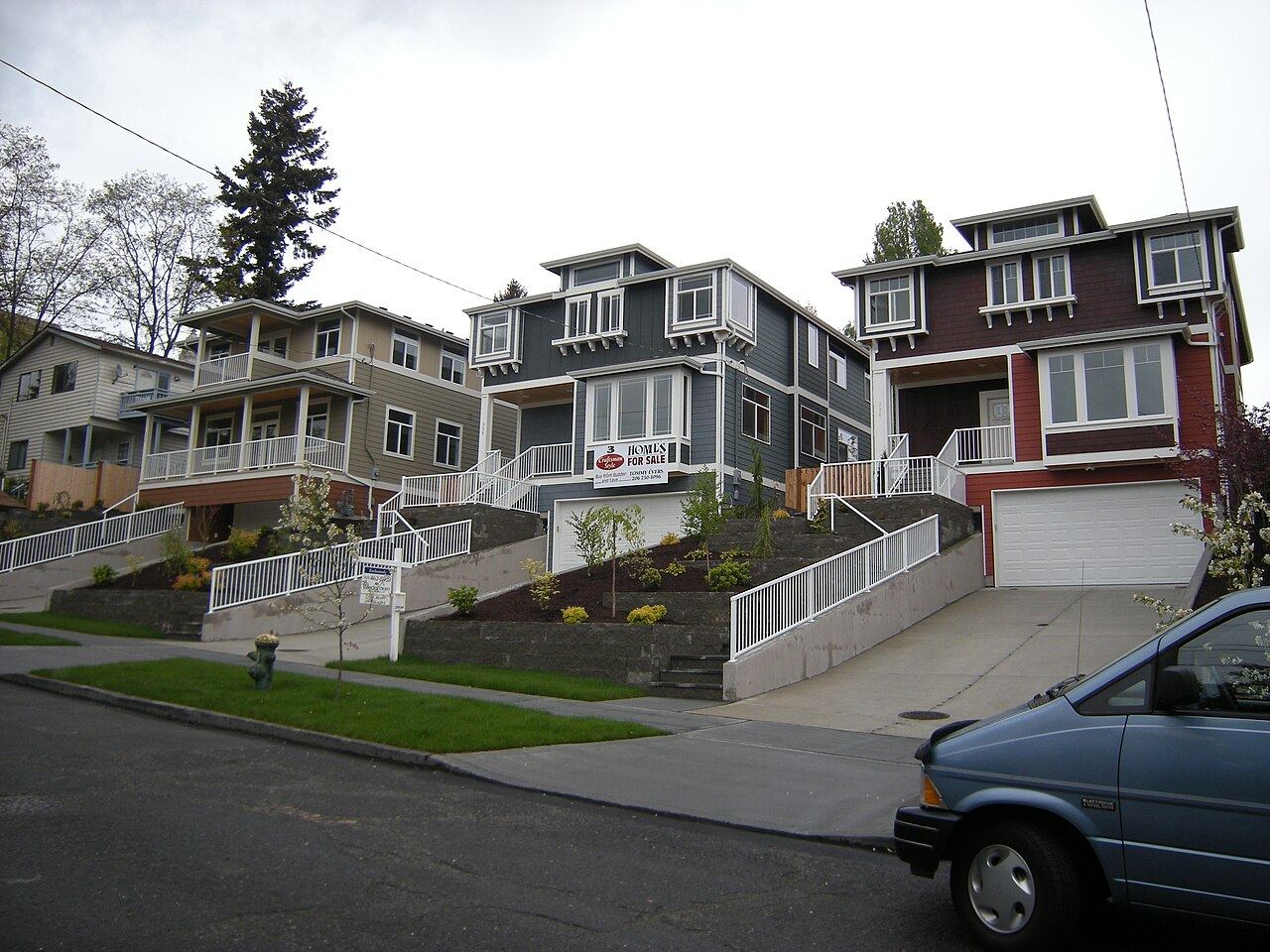
If you are weighing more than one unit — a cottage against a duplex or fourplex on the same lot — the whole frame changes, and that math lives in its own place: middle housing versus a DADU, which actually pays.
The honest risks, and how to read them
A cottage is not a bond. Four risks sit inside the payback number, and you should know each before you spend a dollar.
- Rent goes soft. Seattle rent is not climbing right now — the five series behind the $2,700 figure range from $2,437 to $2,878 for a two-bedroom, and the indexes are flat-to-down year over year. $2,700 is a planning number, not a promise; the engine's band is $2,425–$2,700.
- Build cost overruns. The four site items — side sewer, electrical panel, trees and trench distance — are the ones that reset budgets, and each is knowable before you sign. That is what the customized feasibility report measures for your address.
- Rate risk. A HELOC is variable. The 7.25% used here is a planning rate; if the note reprices higher, the negative year-one number gets worse.
- Single-tenant concentration. One unit means your vacancy is either 0% or 100%, never 6%. The 6% figure is an average over time, not a steady state.
None of this makes a cottage a bad idea; it makes the return a real one, with real variance. The September market notes cover why rent, not appreciation, is carrying the decision, and the rental income guide has the full line-by-line net.
Getting the per-lot number
Everything above is citywide. Your actual Seattle DADU ROI depends on four things no rent index can give you: whether your lot fits a cottage, what it costs to build there, your parcel's fee envelope and levy code, and whether the neighborhood will support the rent you need.
Lot geometry decides the first one. A Ballard lot with an alley gets a 0-foot rear setback and a short sewer run; a deep Wedgwood interior lot stretches the trench and the cost. The neighborhood feasibility profiles lay out those measured differences block by block, and the free homeowner checklist walks the go/no-go questions before you spend anything.
For the exact numbers on your address — buildable rectangle, fees, capacity charge, drainage tier, levy code, and a fifteen-year cash flow built from them — that is what the projection below is for.
Your address, your rent, your 15-year cash flow — all in.
A PDF built from your parcel's measured buildable zone, fees, drainage tier, and levy code, with a year-by-year cash-flow table — the same engine as this article.
- Projected rent range by bedroom count, adjusted for your neighborhood and transit
- Design-and-build cost and up-front fees from the site's 2026 rate engine
- King County capacity charge, SPU drainage, and property tax, line by line
- A 15-year cash-flow table with break-even and yield
$59 — delivered by email, automatically
The customized feasibility report is the escalation path if the numbers look good but you want the whole lot measured — setbacks, trees, critical areas, utilities, and the permit path — before you commit. If you would rather work it through yourself first, the free Pro Guide walks the same rules on paper.
Frequently asked questions
How long does a Seattle DADU take to pay for itself?
On rent alone, a two-bedroom cottage costing about $414,500 design-and-build (plus $18,150 of permits, studies and site prep) and renting for $2,700 a month pays back in about year 17 when paid in cash, counting 2% rent growth for 3 years then 3%, 6% vacancy, 7% maintenance and 8% property management. The payback lands sooner if you count the value the cottage adds to the property and the right under RCW 36.70A.681 and SMC 23.42.022 to sell it separately later through a condo or unit-lot subdivision.
Is a Seattle DADU cash-flow positive from year one?
Built with cash, yes. A $414,500 two-bedroom cottage renting for $2,700 a month nets about $17,759 in year one after vacancy, a month of lease-up, maintenance, management, insurance, the King County capacity charge and property tax. Financed on a $331,600 HELOC at 7.25% over 20 years, the payment of about $31,452 a year exceeds that net, so the cottage is cash-flow negative (−$13,693 in year one) until rent growth catches up.
What is the cash-on-cash return on a Seattle DADU?
On the worked example, $17,759 of year-one net on $432,650 invested (build plus fees) is 4.1%, rising to 4.7% once the lease-up month is behind you. At the bottom of the band a $336,000 build returns 5.2%, and at the top a $493,000 build — where recent Seattle builds are landing — returns 3.3%.
Does financing a Seattle DADU with a HELOC make sense?
It depends on the rate and term. At 7.25% on a 20-year amortization, the debt service on a $331,600 draw is about $2,621 a month, more than the cottage's first-year net, so it is negative leverage early on. At 6% the shortfall is −$10,753 in year one; at 9% it is −$18,037. A longer amortization or an interest-only draw period changes the answer. Run the numbers on your own rate before committing.
This article is educational and preliminary. It is not financial, investment, tax, or legal advice, and it is not a projection of future rent, returns, or appreciation. Rent, expense, cost, and financing figures are planning estimates computed by this site's engine from the dated public sources it cites (calculator version roi-v2) and may differ materially from your result. Fees, rates, and code change. Verify current figures against Zillow, SPU, King County, and SDCI schedules at the time of your application, and consult a qualified lender, accountant, or financial professional before making any financial decision.