Seattle DADU & real-estate reports
Start here: two reports, two different questions.
One hands you every record the County and the City already hold about the house standing on your lot. The other measures what you could build there. Under those two, five focused reports that each answer a single question from your address, in minutes.
Seattle Property Records Dossier
Who owned it, what was built, what was permitted, and what is buried in the yard — the assessor parcel and tax roll, every sale with its recording number (and the scanned deed where the Recorder serves one), every permit we can retrieve (including any 1894–1970 microfilm scans SDCI holds for the address), tanks and hazards, the side-sewer and water cards, and the historical aerials that cover the parcel. One PDF, every source named. It hands you the record; it does not measure your lot.
See the dossier — $13.99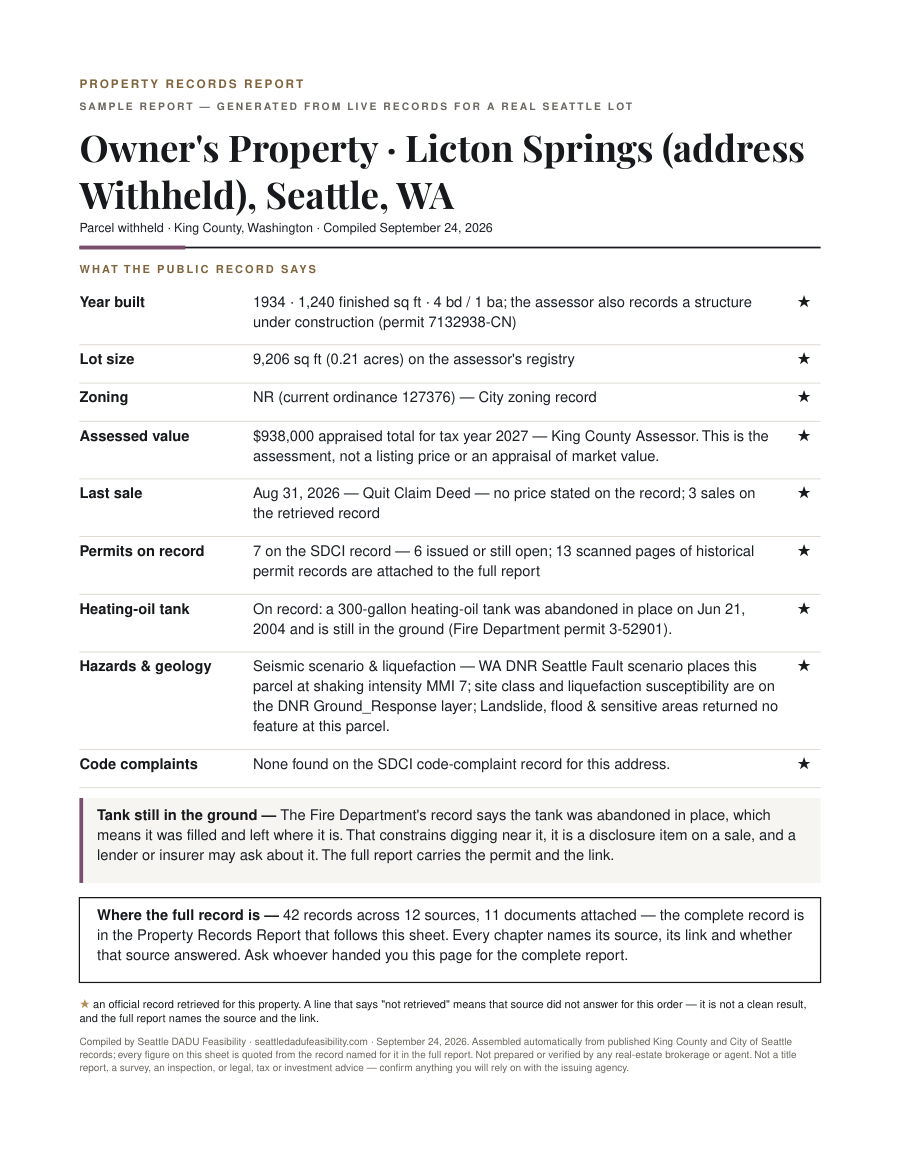
Customized Feasibility Report
Every factor a developer checks — zoning, setbacks, buildable envelope, critical areas, trees, utilities, and a permit path — measured on your parcel, then reviewed by a person before it reaches you. It measures the lot; it does not hand you the documents.
Get your report — $149Different jobs, not tiers. The report measures the lot you might build on; the dossier is the paper trail on the house already there. At $13.99 the dossier is also the cheapest way to see how we work before you spend $149.
Automated reports
Or ask one question
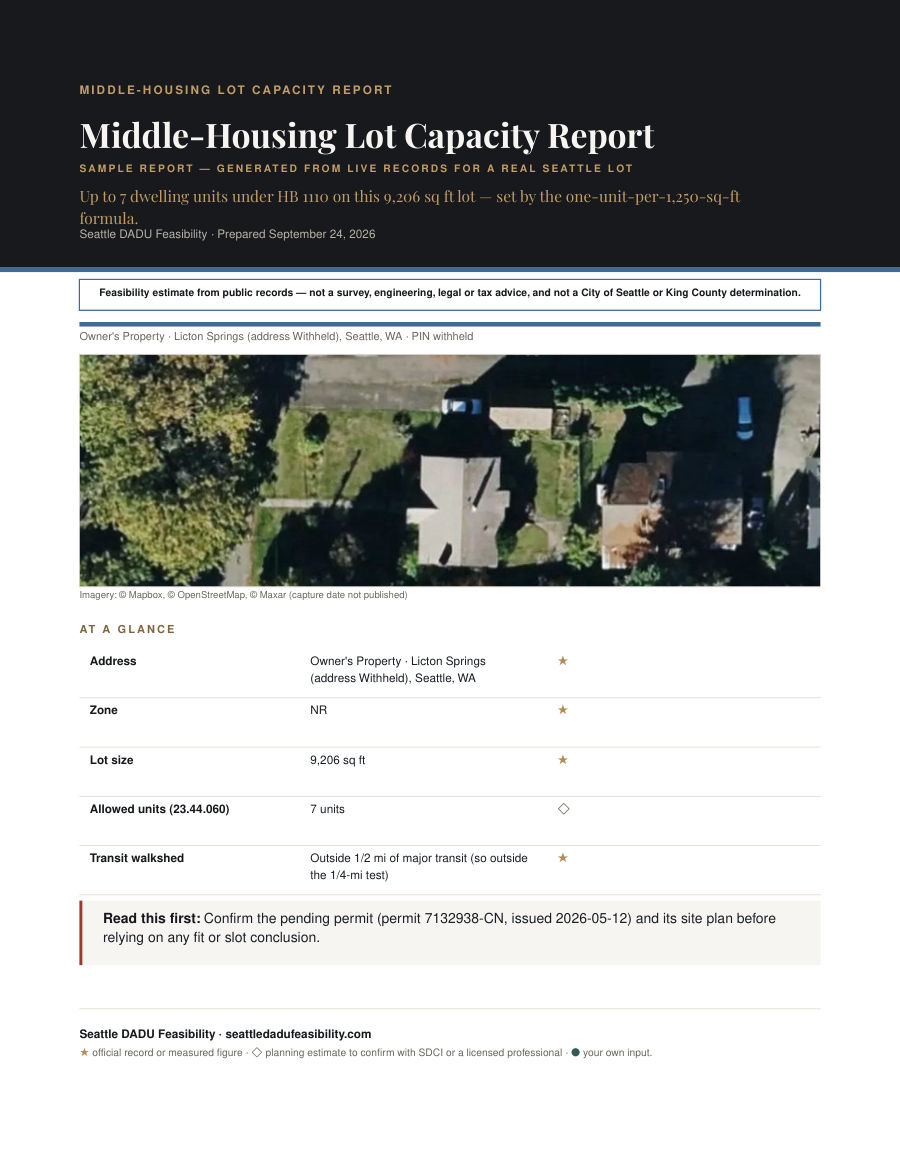
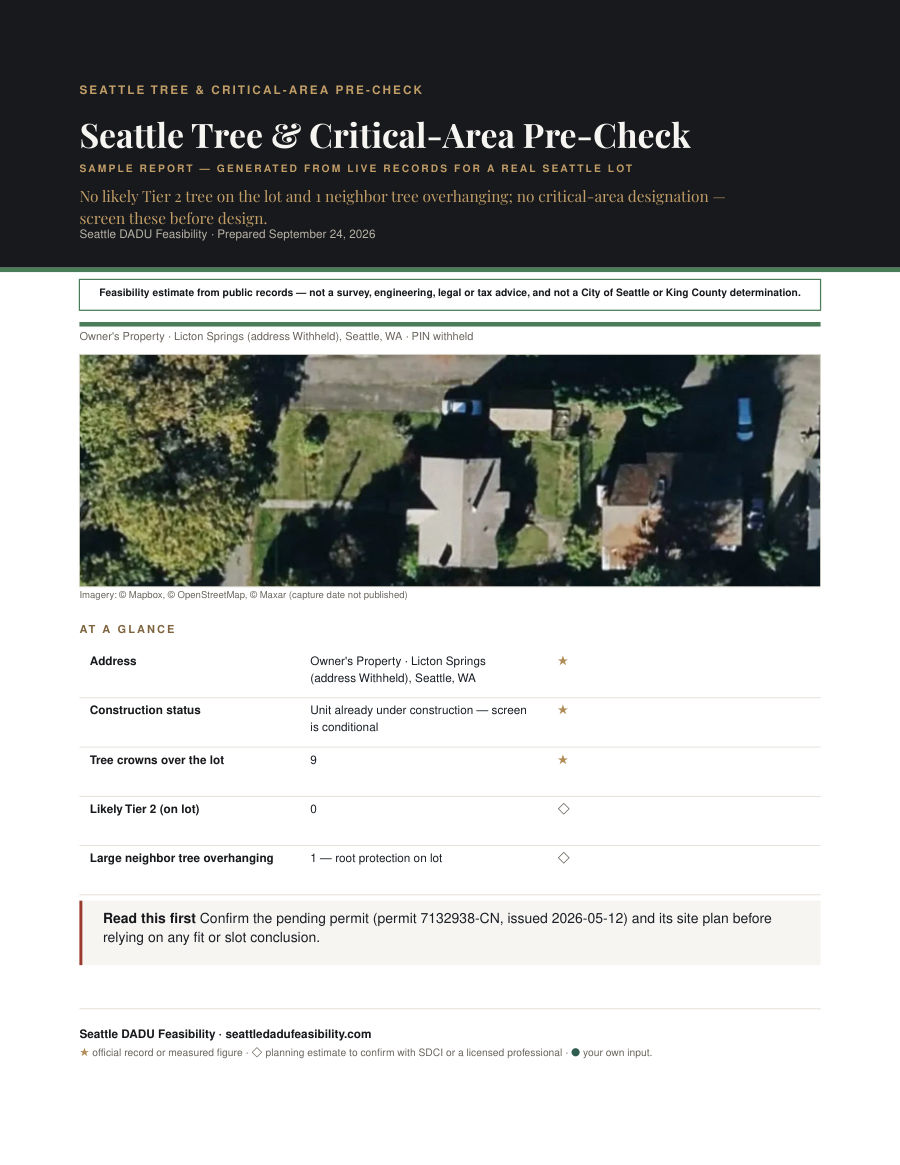
Five focused reports, one decision each, $39–$79. Every cover below is the real cover of its sample — priced, paged, and generated from your address the moment payment confirms.
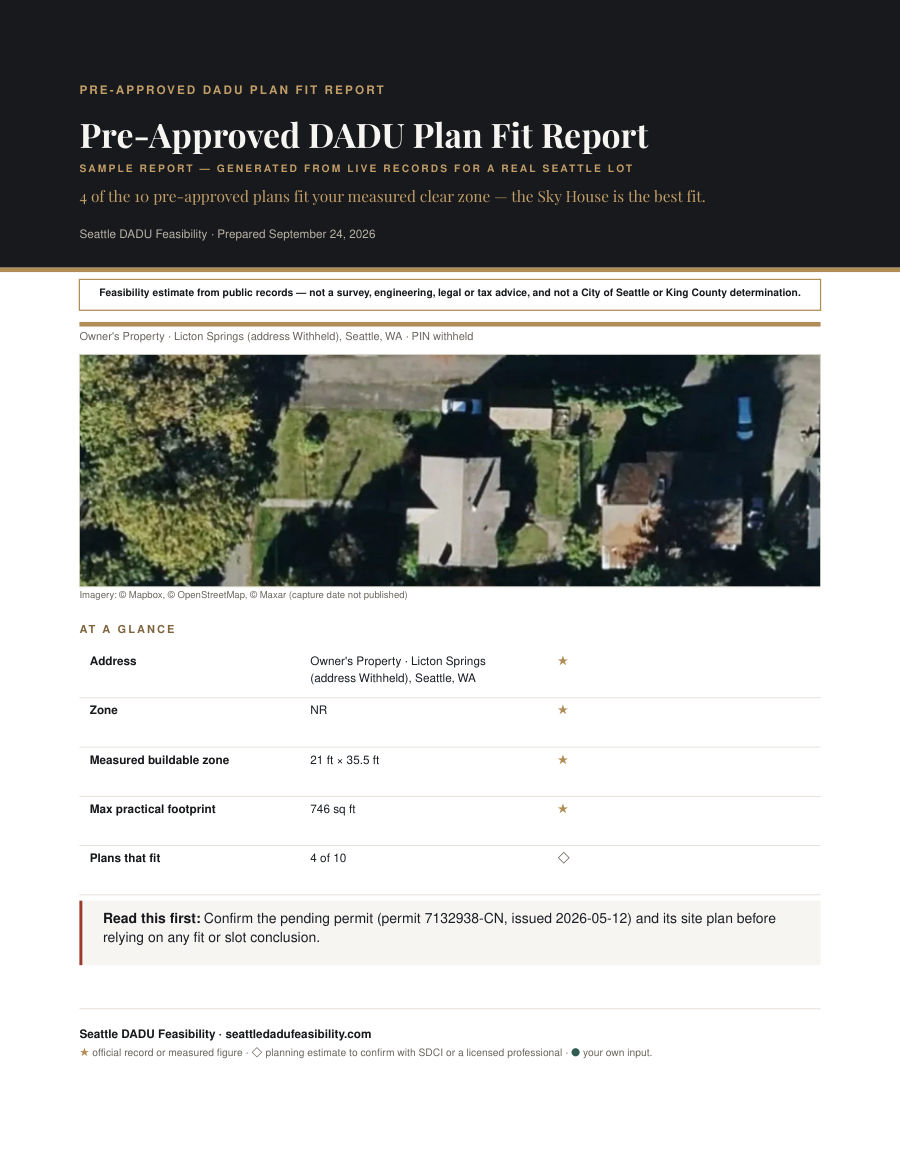
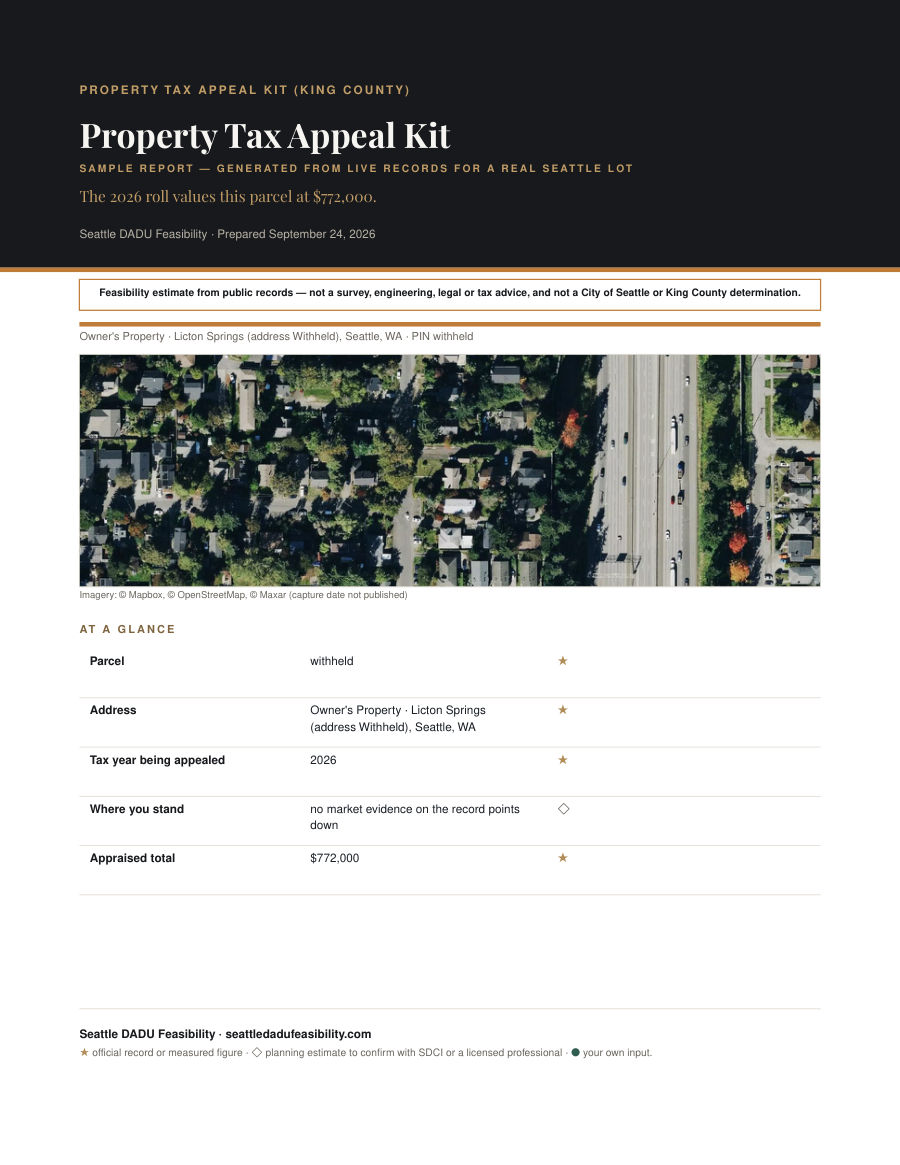
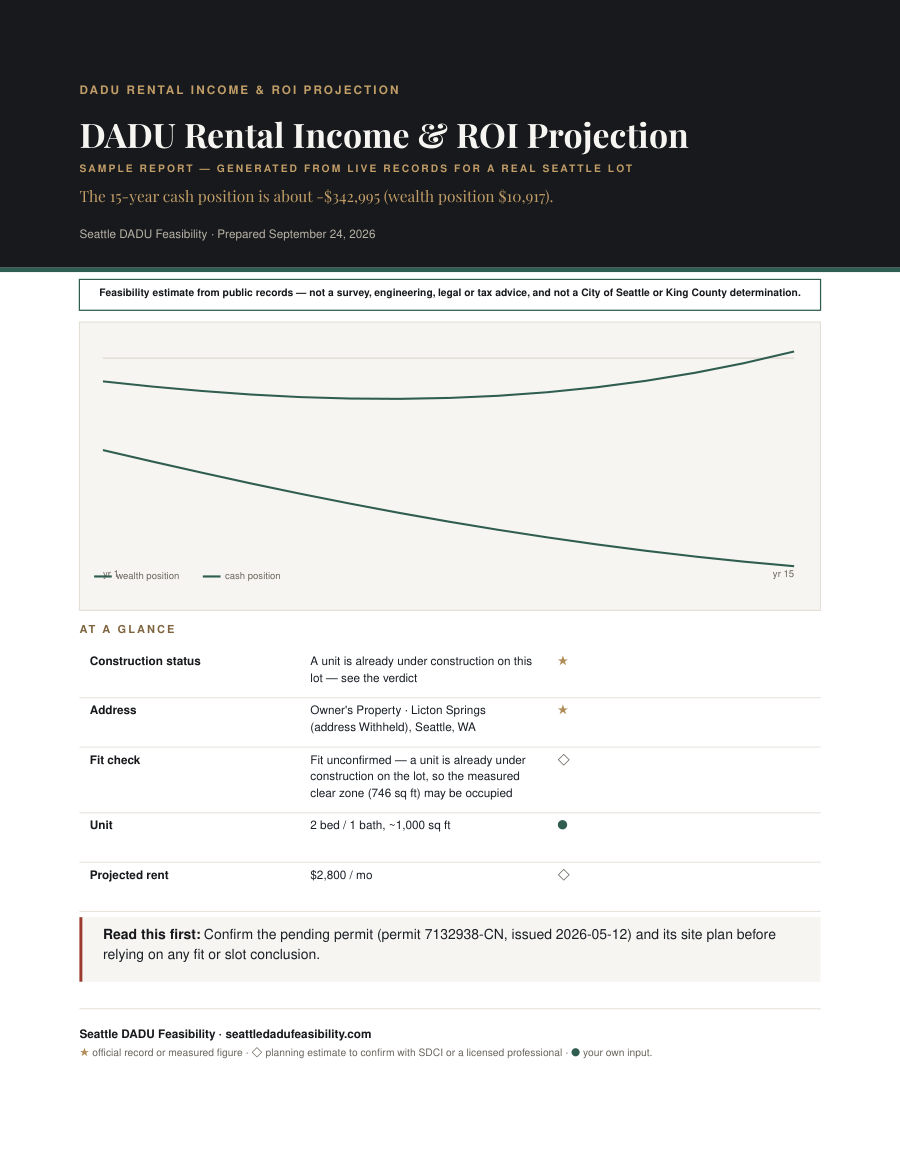
The assistant
Ask about your lot, screen an address, and render a pre-approved plan on your house — free chat, renders cost 1 credit.
Ask about your lotHow it works
-
Enter your address
We match it to the King County parcel on the spot and show you the matched address, parcel number and lot size. You confirm it is your property before you pay.
-
Automated pull
City of Seattle and King County records are run against your address automatically.
-
PDF in your inbox
The report is generated and emailed the moment Stripe confirms payment.
Report questions, answered
Which of the two should I start with?
Ask which question you have. If it is "what could I build here", start with the $149 Customized Feasibility Report: it measures your parcel — buildable envelope, setbacks, trees, critical areas, utilities, fees, permit path — and a person reads it before it goes out. If it is "what has already happened here", start with the $13.99 Seattle Property Records Dossier: it hands you the records themselves, including the documents. Neither replaces the other, and the dossier is cheap enough to buy first.
How are these different from the $149 Customized Feasibility Report?
Each of these is a single-purpose, fully automated screen — one question, answered from your address and delivered as a PDF the moment Stripe confirms payment. The $149 report is the complete human-reviewed study: every factor, measured and explained, then checked by a person before it reaches you.
How fast do I get it?
In minutes for the five single-question reports, and within an hour for the records dossier, which fetches many more sources. These products are deterministic public-record screens, so they are generated and emailed automatically the moment payment confirms — no human in the loop.
What if the answer is 'no' — a plan doesn't fit, or no units pencil out?
That is the most valuable report you can get. It saves you the $8,000–$15,000 design fee (or a $400–$1,200 arborist report) you would otherwise spend before finding out. A clear 'no' now is a bargain.
Do these replace the $149 report?
No. They answer one question well. The $149 report covers the full picture — zoning, setbacks, buildable envelope, trees, critical areas, utilities, fees, and a permit path — reviewed by a person.
Need the whole build question answered?
The $149 Customized Feasibility Report is the full build study.
Zoning, setbacks, buildable envelope, critical areas, trees, utilities, fees, and a permit path — measured from 30+ City and County records and reviewed by a person before it reaches you. It goes deepest on “what can I build here”; it does not replace the rent projection, the tax appeal, the unit-count verdict or the records dossier, which each answer a question of their own.