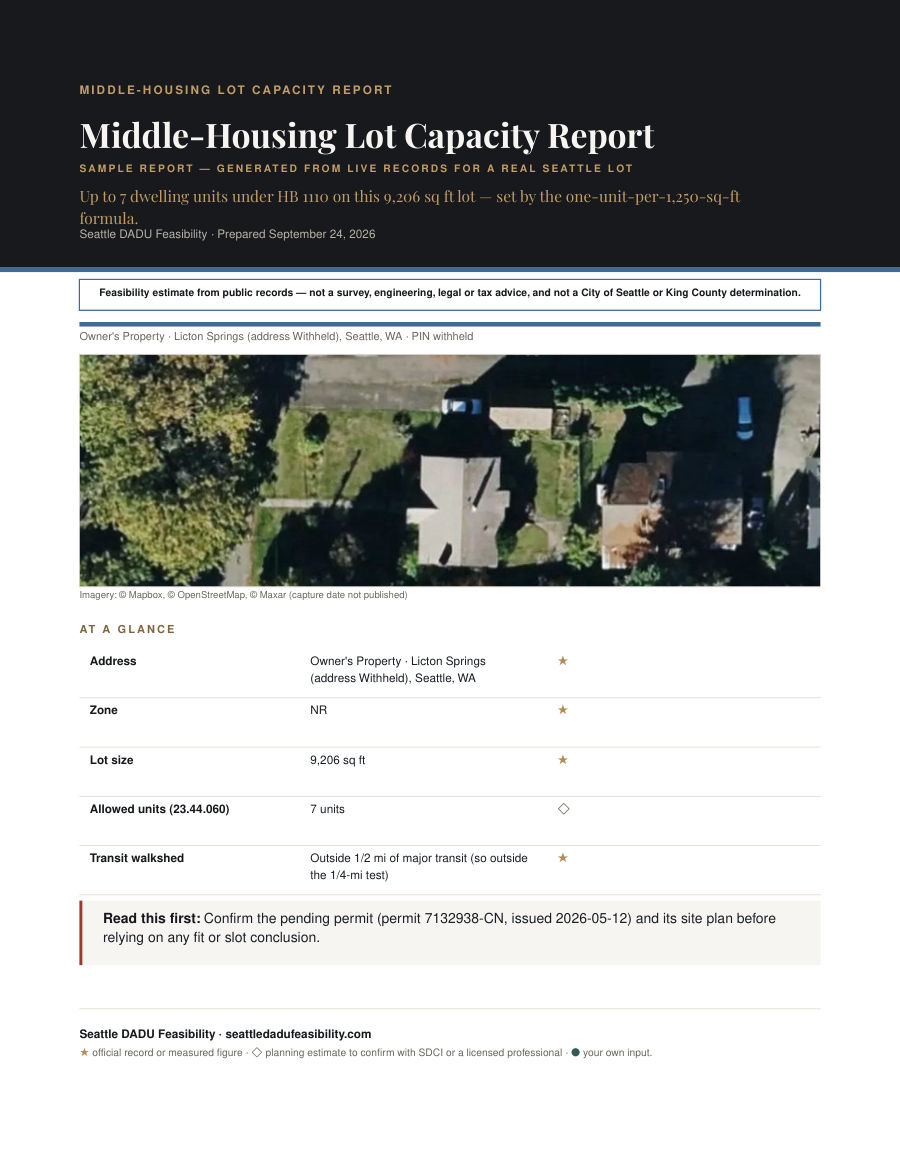
Middle-Housing Lot Capacity Report

How many units HB 1110 lets you build on your Seattle lot.

The allowed unit count is the greater of a four-unit floor (six within a quarter mile of major transit or with two affordable units) and a density formula of one unit per 1,250 sq ft (one per 600 sq ft for stacked flats). This report gives you the verdict, the transit qualification, and a simple massing for your specific parcel.

$49 one-time · 12-page sample · In minutes

PDF by email in minutes · Stripe-secured · you confirm the matched parcel before you pay

Photo: New townhouses on Lakeview Blvd E, Seattle — Joe Mabel — CC BY-SA 3.0

Try it

How many units on your lot?

The allowed unit count is the greater of a four-unit floor (six within a quarter-mile of a major transit stop or with two affordable units) and a 1-per-1,250 sq ft density formula — or 1 per 600 sq ft for stacked flats (SMC 23.44.060). This widget runs the same rule as the report.

Get the verdict for your lot

Inside this dossier

A 12-page sample, chapter by chapter.

The chapter index of your report — the real table of contents from the sample, rebuilt for your address at purchase.

  1. Cover1
  2. Report disclaimer2
  3. Your property from above5
  4. Executive summary6
  5. Your allowed units6
  6. Transit qualification6
  7. Density, FAR & coverage7
  8. Simple massing7
  9. Constraints on the massing8
  10. DADU cross-check8
  11. What would change this verdict8
  12. Worked examples from real Seattle lots9
  13. What to do next10
  14. Sources11
  15. Before you rely on this3
  16. Next step: the full study12

Sample pages

How it reads, page by page.

Unit-capacity verdict — three pages from the sample PDF, generated from a real Seattle address. Your copy is built from your own parcel.

Method & sources

Methodology: where every figure comes from.

Every figure follows the same methodology — live public records or a dated constant, marked ★ official or ◇ estimate.

  • HB 1110 (RCW 36.70A.635(1)(b))4-unit floor; 6 within one-quarter mile walking distance of a major transit stop or with two affordable units
  • Seattle NR code (SMC 23.44.060, Ordinance 127376)1 unit / 1,250 sq ft (1 / 600 stacked) vs the 4/6-unit floor; FAR and lot coverage
  • King County parcels + SDCI zoning and transitparcel geometry, zone, major-transit walksheds (quarter-mile confirmed on SDCI's Property Information Map)
  • Environmentally critical areas + tree layersconstraints on the massing

Worked examples

Real Seattle lots, run through this report.

Three Seattle addresses measured with the same engine, so you can see how the analysis lands on lots like yours.

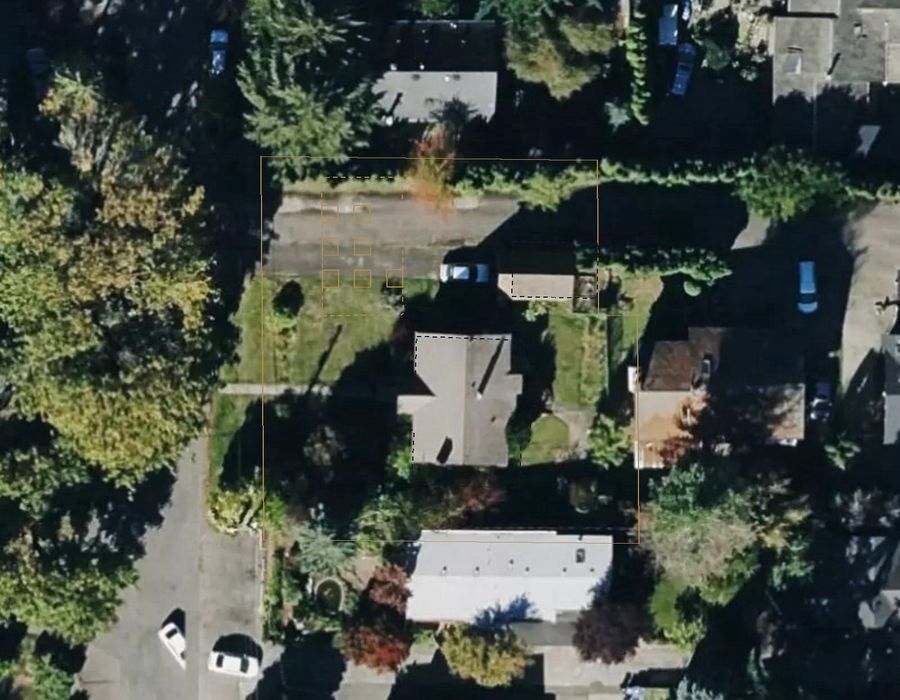
Licton Springs — 7 units allowed
Aerial with the report's measured overlays drawn to scale.

Worked example 1 · Licton Springs

7 units allowed

Zone
NR
Lot size
9,206 sq ft
Allowed units (23.44.060)
7 units
Transit walkshed
Outside 1/2 mi of major transit (so outside the 1/4-mi test)

This Licton Springs lot is 9,206 sq ft in an NR zone, and the SMC 23.44.060 density formula allows 7 units — more than the 4-unit floor, because one unit per 1,250 sq ft clears 7 on a lot this size. The transit test does not change that number, so the walkshed is not what is doing the work here. A DADU counts as one of those units. The practical ceiling is lot coverage and FAR, not the unit count — confirm the number with SDCI's land-use desk before any design spend.
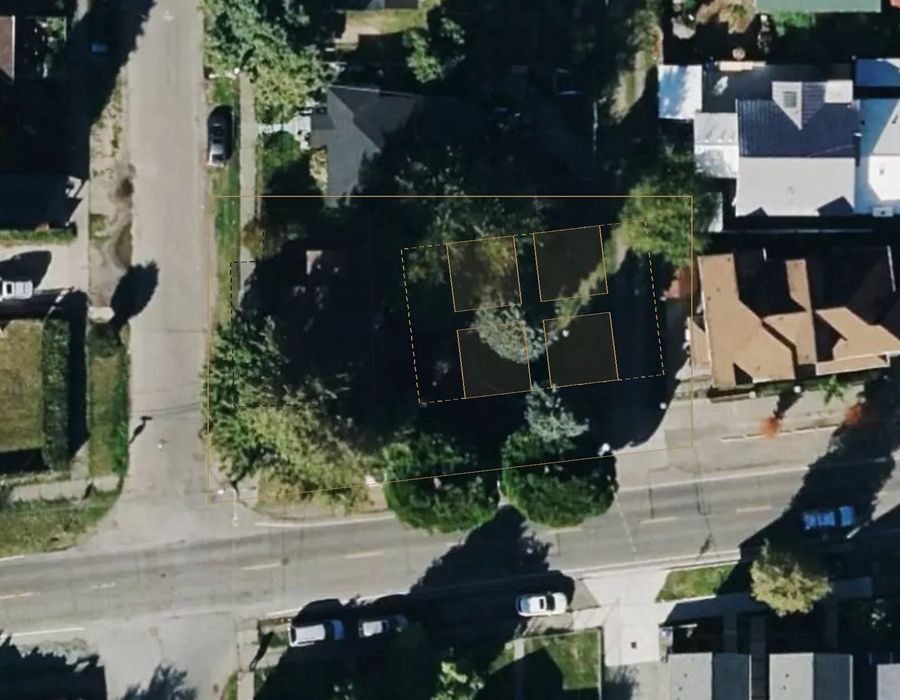
Beacon Hill — 4 units allowed
Aerial with the report's measured overlays drawn to scale.

Worked example 2 · Beacon Hill

4 units allowed

Zone
NR
Lot size
5,700 sq ft
Allowed units (23.44.060)
4 units
Transit walkshed
Outside 1/2 mi of major transit (so outside the 1/4-mi test)

This Beacon Hill lot is 5,700 sq ft in an NR zone and sits outside the major-transit walkshed, so the allowed count is the four-unit floor. The density formula — one unit per 1,250 sq ft — comes out at 4, so the floor is what sets the number. A DADU counts as one of those units. Lot coverage caps the build, and coverage, not the unit count, is what will bind first. Confirm the count with SDCI's land-use desk before any design spend. This is a density screen, not a permit determination.

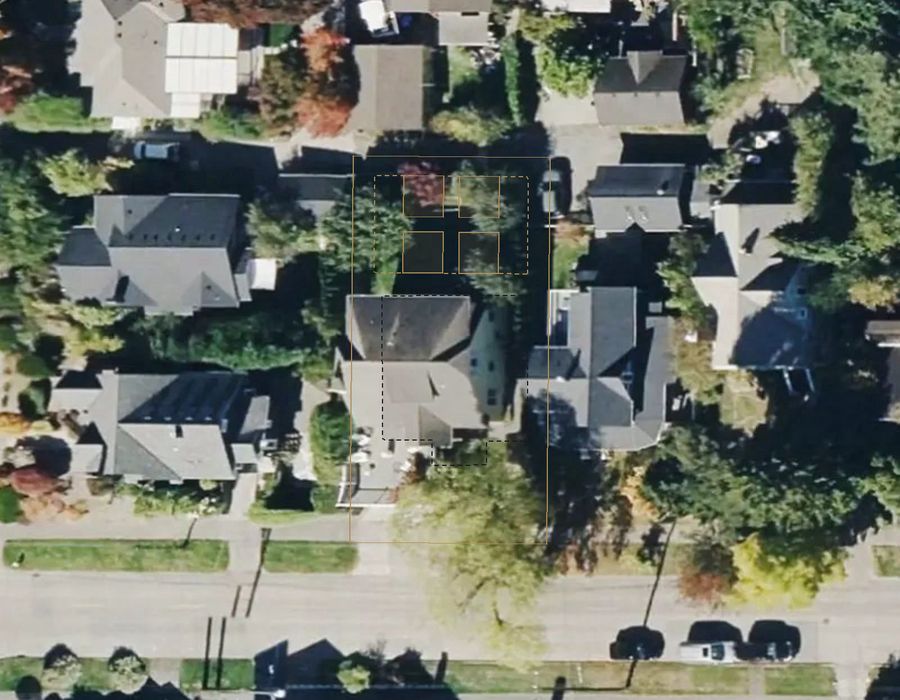
Ballard — 4 units allowed
Aerial with the report's measured overlays drawn to scale.

Worked example 3 · Ballard

4 units allowed

Zone
NR
Lot size
5,100 sq ft
Allowed units (23.44.060)
4 units
Transit walkshed
Outside 1/2 mi of major transit (so outside the 1/4-mi test)

This Ballard lot is 5,100 sq ft in an NR zone and sits outside the major-transit walkshed, so the allowed count is the four-unit floor. The density formula — one unit per 1,250 sq ft — comes out at 4, so the floor is what sets the number. A DADU counts as one of those units. Lot coverage caps the build, and coverage, not the unit count, is what will bind first. Confirm the count with SDCI's land-use desk before any design spend. This is a density screen, not a permit determination.

Questions, answered

Before you order.

How many units can I actually build?

The greater of a four-unit floor (six within a quarter-mile of a major transit stop or with two affordable units) and the density formula: one unit per 1,250 sq ft, or one per 600 sq ft for stacked flats. On a 6,250 sq ft lot the formula already gives five, so the floor stops mattering on larger lots. ADUs count toward the total. The report gives the number for your specific parcel.

Is the transit test a quarter mile or a half mile?

A quarter mile. SMC 23.44.060 (Ordinance 127376) and RCW 36.70A.635 set the six-unit floor for lots within one quarter-mile of a major transit stop; Seattle's half-mile major-transit walkshed is the parking-exemption distance, not the density test. The report says which test it measured and marks a six-unit floor it could not confirm as needing verification.

Does this report cover Lowrise (LR) or other non-NR lots?

No. The middle-housing unit floor and the 23.44.060 formula govern Neighborhood Residential (NR) lots. An LR, RSL, NC or other zone sets its unit count by that zone's own density and FAR rules, so the order form stops before payment when the matched parcel is not NR.

Is this an SDCI determination?

No. It is a zoning and density estimate from the current code. Unit counts, FAR, and design standards change, so confirm with SDCI before committing.

Does a DADU count toward the units?

Yes. Accessory dwelling units are part of the total unit count under the middle-housing rules, and the report shows how a DADU fits into — or competes with — a multi-unit buildout.

Read first — free

The free Seattle guides behind this report.

Everything this report measures is explained for free first. Read the guide, decide whether you still want it measured for your own address.

Step 1 of 3

Tell us about your lot

Pay on Stripe at step 3
Photos of your house and yard Optional — up to 5, JPEG/PNG
  • Stripe-secured
  • Delivered in minutes

Need the full picture?

This report answers one question. The $149 Customized Feasibility Report covers zoning, setbacks, trees, critical areas, utilities, fees and a permit path — reviewed by a person before it reaches you.

Get the report — $49 All reports